


There is no better gateway to competitive running than the 5K race; at 3.1 miles, it’s easily the most accessible racing distance — and it can light the spark that inspires runners to go even further. It’s also a longtime favorite of runners worldwide; training for a 5K takes less time and is less physically demanding than the 10K, half marathon, or full marathon.
Training for longer distances includes obstacles that can make commitment a challenge; ramping up for half or full marathons means being mindful of your fitness level and any strength training you’re doing, as well as your rest days — not to mention the time commitment that both races demand, which can amount to several hours of running each week.
That’s where the training schedule for a 5K comes in: it’s the perfect choice for advanced and beginner runners alike, serving as a building block for people who are just starting out or those looking to build on their running regimen amidst a busy schedule.
We circled back with Exos trainer and running expert Alexandra Swatloski, who we also spoke to for our guide on Training for a 10K, for some insights on how to prepare for a 5K: “It’s a good starting distance for those who want to eventually run farther. It’s also attainable. No matter what physical activity you choose to participate in, if your initial goal is not realistic, it is going to deter your confidence and overall view of your capabilities,” Swatloski says. “A 5K is an achievement, but also a strong jump-off point for future goals and longer distances.”
Our outline for how to train for a 5K will set you up for success, exploring different skill levels and terrains, as well as more tips to help you prepare for race day.
5K TRAINING PROGRAMS
Before we dive into training plans and how to prepare for a 5K, it’s worth going over some fundamentals — specifically, the benefits of running, how to choose your running shoes, and other gear you should consider.
Our beginner’s guide to running lays out all the important steps to consider before lacing up for the first time. What’s more, we also have a detailed piece on how to choose running shoes that are right for you (Swatloski recommends the Boston 12 for training runs and mid-distance races), as well as a list of essentials for every runner, including apparel and other important accessories.
Once you feel ready to start training for a 5K and logging some miles, try out one of our 5K training plans below — ranging from beginners to experts.
5K TRAINING PLANS FOR BEGINNERS
As a preamble to our 5K training plan for beginner runners, we suggest starting out with the running/walking approach if you’re taking on a 5K race for the very first time; it can build endurance and make the entire process less intimidating, as it splits the distance up into manageable intervals.
All it involves is running for one minute and then walking for one minute, then two minutes each, three minutes each, and so on. You can also change up the ratio like this:
- 1-minute run, 5-minute walk
- 2-minute run, 4-minute walk
- 3-minute run, 3-minute walk
- 4-minute run, 2-minute walk
- 5-minute run, 1-minute walk
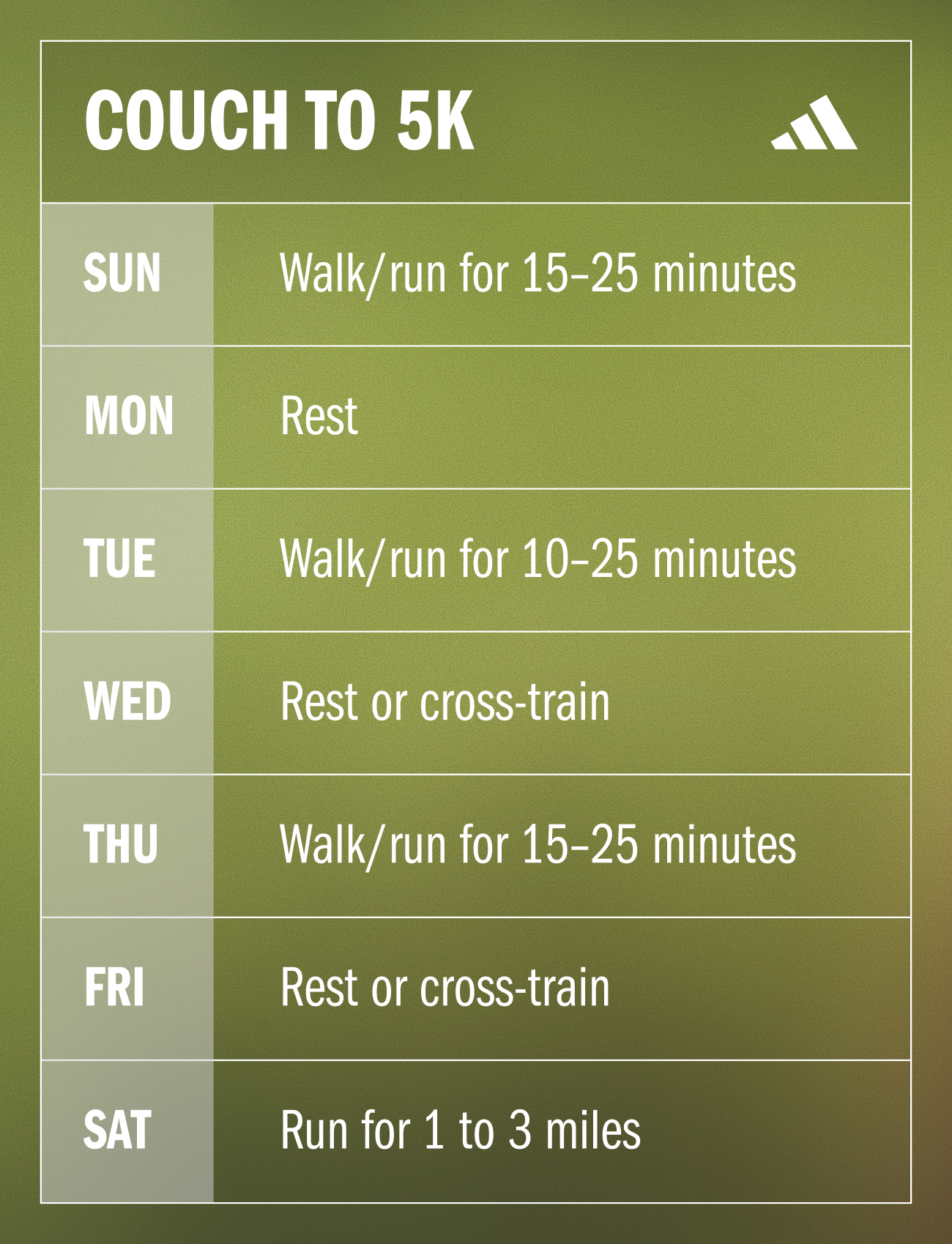
COUCH TO 5K
Once you feel like you’re in the swing of things, try out our Couch to 5K plan; it’s ideal for beginners who want a training schedule for a 5K that allows them plenty of time to prepare.
We’ve structured this to be done over five weeks, and you can lengthen your runs or increase their intensity as you go on.
TRAIN FOR A 5K IN TWO WEEKS
If you’ve already been exercising and training for a few months, this routine can prep you for a 5K in about two weeks.

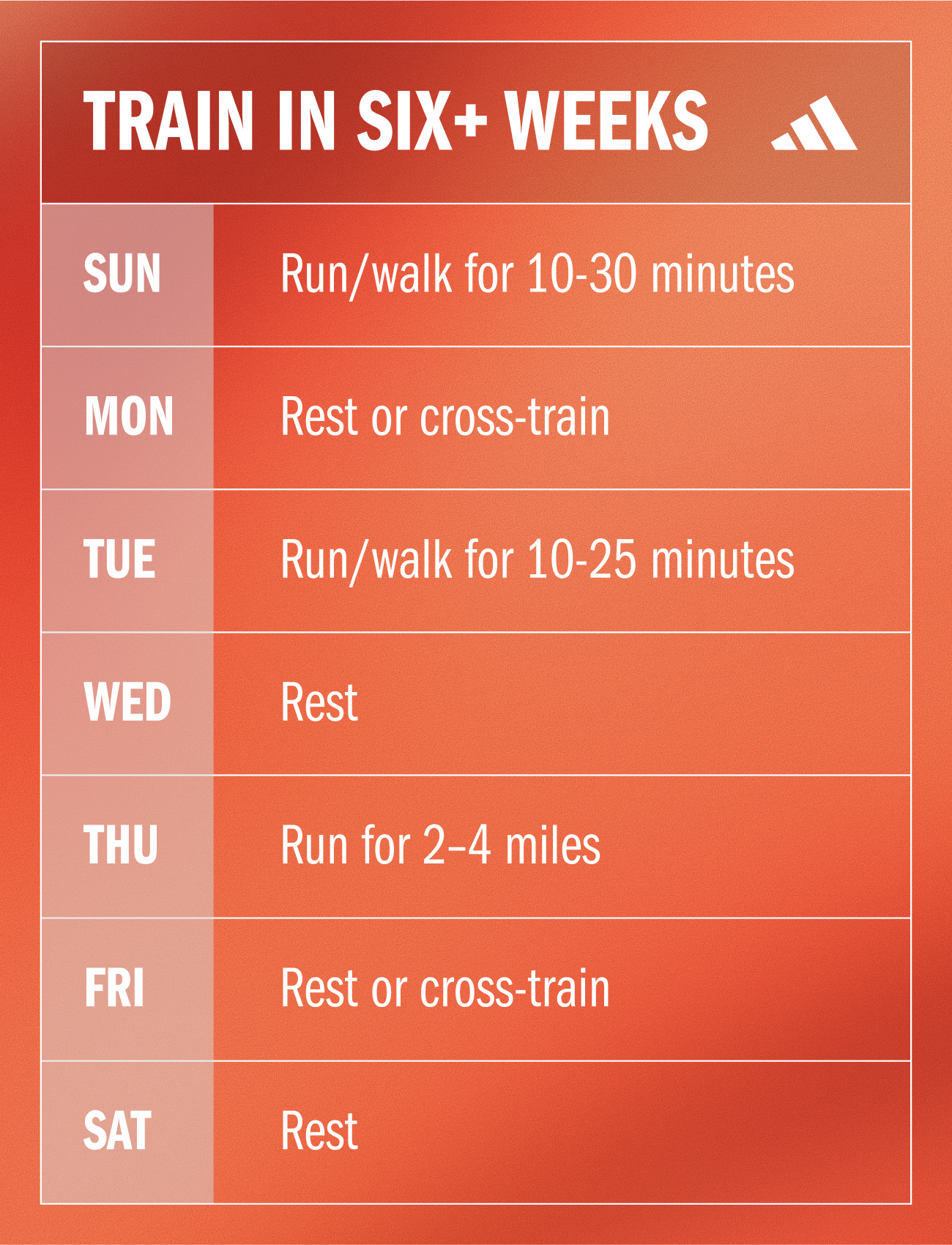
TRAIN FOR A 5K IN SIX+ WEEKS
Beginner runners can try out this regimen to allow for extra prep time. Like the Couch to 5K plan, you can increase the intensity and distance of your runs as you get closer to race day.
INTERMEDIATES’ 5K TRAINING PLAN
For those who already run about fifteen miles a week, this four-week plan incorporates a tempo run in addition to distances over the 5K race. You can also add short runs up and down a hill to the tempo run for added prep, maxing out at three repeats.

EXPERTS’ 5K TRAINING PLAN
Similar to the Intermediate plan, we have a training schedule for a 5K for seasoned runners — intended for those who run around twenty miles per week. It also includes longer distances, a tempo run, and hill runs, maxing out at four repeats. Try it out over four weeks.

WHERE TO RUN
Indoor and outdoor running both offer unique advantages to every runner, and they’re equally worth exploring while getting your bearings and training for a 5K for the first time. Here’s a quick overview of each.
INDOORS
Running indoors can mean either on an indoor track in a gym or, more commonly, on a treadmill. Both are suitable options when considering how to train for a 5K and can help prepare you for more challenging terrains outdoors.
PROS
1. Convenience, control, and customization: Treadmills allow you to adjust every aspect of your run, from the incline to the pace, and can provide specific data about your workout results — all without ever leaving your own home or gym.
2. Shelter from weather conditions: Enjoy your run from the safety of being indoors during inclement weather, such as rain or snow, or during potentially extreme heat in the summertime.
3. Injury prevention: The softer surfaces of an indoor track or treadmill can help absorb the impact on your joints, putting less stress on your knees and feet.
4. No traffic: Unlike running outdoors, where you must wait for cars to stop once you reach an intersection, you can run continuously on either a track or treadmill. In the end, this can shave several minutes off your running times and will feel more like an actual 5K race, where traffic is usually stopped for runners.
CONS
1. Monotony: Perhaps the biggest drawback to running indoors is the repetition of staying on the same treadmill or track for an extended period of time, which can start to feel tedious and unexciting.
2. Less intensive: By design, the controlled environment of running indoors does not exactly mimic the terrains of running outdoors, like streets and trails, and will not engage as many muscles.

OUTDOORS
Once you’ve gotten used to running indoors, it’s worth lacing up and trying out a route through your neighborhood or a nearby trail; the excitement and engagement of running outdoors entices many seasoned runners, and it serves as a critical part of any 5K training plan for beginners — while also posing some risks that should be mentioned.
PROS
1. Accuracy: 5K races are generally held outdoors, so finding a safe route in your city or a nearby trail will better prepare you in training for a 5K and the conditions you will face on race day.
2. Better workout: By incorporating hills and more varied terrains, you can burn more calories and engage a wider range of muscles.
3. Change of scenery: Whether it’s through the city or a trail in the woods, running outdoors into new territories can be mentally refreshing and invigorating.
CONS
1. Risk of injury: Uneven sidewalks in the city, rocks in your trail path, and slippery surfaces like mud all pose dangers that could result in tripping, rolling your ankle — or worse — while you’re going at full speed. Running on concrete may also be hard on your joints.
2. Weather: Running outdoors means you are at the mercy of weather conditions, including wind, rain, humidity, and heat.
3. Traffic stops: If you’re training in a city, you may frequently have to stop at busy intersections — which can break up your rhythm and add more time to your run.

MORE TIPS FOR RUNNING A 5K: MINDSET AND MORE
5 MISTAKES TO AVOID
From forgetting to hydrate to lack of sleep, we’ve compiled five of the most critical mistakes runners can make in our piece on What to Avoid After Running; they’re some of the steps that get frequently overlooked and can be detrimental to your improvement as a runner.
In particular, it’s also important to remember to stretch after your runs. Swatloski recommends “anything that targets the hips, such as a seated shin box hip rotation, the half kneeling hip flexor stretch and Hip CARS – wall ankle mobility, World’s Greatest Stretch, thread the needle-glute/hamstring specific stretches and mobility such as the inverted hamstring stretch and knee hug.”
“After a series of static stretches,” she continues, “move into dynamic stretches like butt kicks, high knees, leg swings, skipping and arm circles.”
Many runners also neglect to hydrate enough: “Staying hydrated before and after all your runs will greatly affect your performance,” Swatloski says. “Generally, on runs lasting 60 or more minutes you should drink 4-6 ounces of water every 15-20 minutes. Make sure to factor in weather conditions when planning your water intake.
“If you are running on a warmer day, you will need more water and electrolytes due to an increased loss of fluids through sweat.”

5 RUNS THAT CAN IMPROVE YOUR PERFORMANCE
If you really want to lock in and elevate your running game, read up on How to Improve Your Running Performance; we detail five different types of runs that can greatly improve your pacing, endurance, and speed over time, including tempo runs, crescendo runs, and trail runs.
CROSS TRAINING CAN HELP
Many elite runners are serious about cross training to help elevate their performance — and if you’re just learning how to train for a 5K, you can certainly benefit from it even by simply trying it out.
“A full body regimen that focuses on one-leg strength, glute strength and posterior chain connection - lateral, rotational, anti-rotational movement and stability - mobility, core strength, muscular endurance and plyometrics will make you a strong runner and help to prevent injuries. It also helps you to become more in tune with your body,” Swatloski adds.
Read our guide on Cross Training Workouts for Runners for an overview of some essential exercises.
MIND YOUR MECHANICS
Making small adjustments to your posture and stride can also help you run more efficiently and reduce the risk of injuries. Check out our 7 Keys to Proper Running Mechanics for a look at some simple corrections that you could greatly benefit from over time.
DON’T COMPARE YOURSELF TO OTHERS
For some parting advice on getting ready to complete a 5K, Swatloski emphasizes the importance of not worrying about how you compare to other runners: “Give yourself grace and understand that everyone starts somewhere. Do your best not to compare your time and fitness to others. Focus on positive self-talk and mindset throughout your training and never lose sight of your goals.
“If running by yourself feels daunting,” she says, “find others to run with if your community allows for it or reach out for resources. Don’t let the bad days discourage you, learn from them, and always listen to your body!”