


For many, running is more than simply a sport or pastime; it’s an enriching, lifelong pursuit of consistent performance. The changes to your pacing and cadence over years of training may not be perceptible in the moment—especially as you take on more recreational running year-round, outside of marathon season. But like any other commitment, it sometimes calls for reassessment.
HOW TO RUN FASTER & LONGER: BEST RUNNING SHOES, BREATHING TECHNIQUES FOR RUNNING, AND MORE
Before delving into speed training and exercises, it’s worth addressing some basics—namely, what shoes you’re wearing and how effectively you’re breathing; with proper care, the right running shoes will protect your knees, feet, and joints as you exert more force during your runs, and breathing correctly will supply oxygen to your muscles, which is crucial to keeping your body relaxed during powerful strides.
More than any one factor, however, the secret of how to run faster and longer is simply consistency; by sticking to a schedule—be it three, four, or five times a week—your body will adapt to neurological and physiological changes resulting from your aerobic development and the optimization of your form. We’ve included links to comprehensive guides on more warmups and prep below, but let’s move on to the workouts first.
SPEED TRAINING
We spoke with trainer and triathlete Sascha Wingenfeld about five tips and tricks on how to run faster that can add variety to your running routines—making your next run more fun and dynamic while enhancing your performance over the long term.
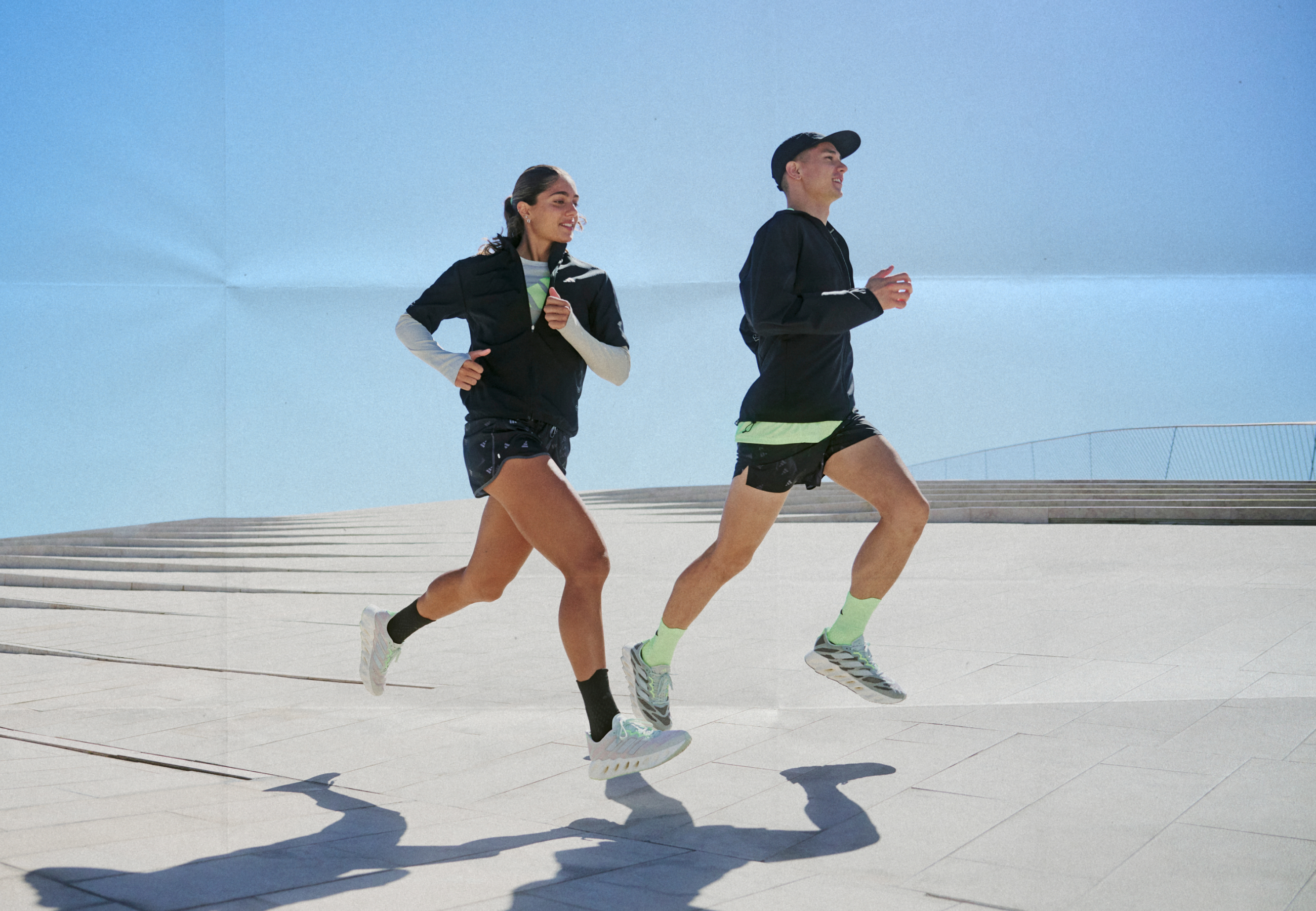
1. HOW TO RUN LONGER
It is said that if you want to run faster, you must run farther—and if you want to run farther, you must run slower.
This plays into our first steppingstone towards improving your pace; by running longer distances, you are gradually conditioning yourself to become more consistent. In order to do this, you will have to slow down to a pace that leaves you feeling like you can run three more miles once you are finished. If you feel comfortable with it, you can also vary your pace up, as this is the cornerstone of a fartlek run.
By design, fartlek training is a more casual way to ease runners into more demanding runs leading up to a race; it helps condition you to become more flexible in terms of speed, step frequency and power over multiple distances. Only in this way can you adjust to different surfaces while training without overtaxing your body. Sascha’s tip: “Play with your pace during your distance runs.”
Here’s how:
From the Swedish word for “speed-play,” “fartlek” training basically involves varying your pace without a specific plan or goal. The intervals and intensity depend on the terrain, and you can mix and match them as you like during your workout. The activity includes all intensities, from slow recovery jogs to high-intensity sprints.

2. HOW TO RUN FASTER: TEMPO RUNS, CRESCENDO RUNS
A midway point between the more casual fartlek runs and explosive sprinting, tempo running is simply maintaining a slower and more consistent pace over longer distances. This is harder than it sounds—and in fact, it is traditionally recommended that your pace should feel “comfortably hard” and that you can sustain it for about an hour. As with fartlek runs, you should feel like you still have effort to give after the run is over. You can also incorporate tempo runs within your long-distance runs for speed training, usually either in the middle or towards the end.
Similarly, a crescendo run is a training exercise involving a systematic increase in intensity. “This method is a very effective option for improving your running performance. Plus, a crescendo run is an awesome fat-burner!”
Here’s how:
Choose a 1 or 2K route and increase your speed between laps without taking a rest.
Example:
Lap 1 at 70 % of your max. heart rate
Lap 2 at 80 % of your max. heart rate
Lap 3 at 85 % of your max. heart rate
Lap 4 at 90 % of your max. heart rate

3. HOW TO SPRINT FASTER: INTERVAL RUNNING, ACCELERATIONS / DECELERATIONS
Once you’ve built up your endurance, break up the monotony of your running by learning how to sprint faster with short sprints during your endurance training. Two examples of this are interval training and acceleration/deceleration sessions. “That keeps your running form dynamic and makes you fast,” said Sascha. You won’t make performance gains if you always run at the same speed. “Your body needs a speed stimulus to be able to actually run faster the next time.”
Here’s how:
Interval training involves short bursts of intense speed with equal amounts of rest, like jogging slowly, or even stopping. A good one to start off with might look like this: warm-up for five minutes by jogging, followed by one minute of sprinting, then cool down for two minutes by jogging or walking. Repeat this four or five times, and end with a five-minute cooldown jog. For an in-depth look at this, read our guide on interval training for beginners.
During an acceleration, you slowly—but steadily—increase your running speed from a recovery pace to a sprint over a distance of 80-100 m.! A deceleration begins with a sprint and gradually slows down to a jog.
Sascha’s tip: You can work this short speedwork into one of your long-distance runs to vary the pace, or you can finish a run with a speed drill like this.

4. HILL SPRINTS
Running is not just about endurance training: your body also requires strength. Sascha recommends learning how to sprint faster by doing hill sprints after your long-distance runs. “This turns your regular run into a complete cardio and strength workout and helps you run with a more powerful stride.”
Here’s how:
To improve your hill sprints, run uphill for about 150 m at 90-95% of your maximum effort. Repeat this drill six to ten times. Make sure to take long, powerful strides and engage your core. Rest on the walk or jog down the hill.

5. TRAIL RUNNING
“Take advantage of the benefits of changing surfaces,” recommends the running expert. Every surface has its own unique challenges. Your body must learn to react to them by unconsciously adapting your stride, foot strike and step frequency. This method is guaranteed to spice up your running training and nip boredom in the bud!
Here’s how:
In this type of running, you leave concrete pavements and asphalt roads behind you. To improve your trail running performance, try to run on unfamiliar terrain and new surfaces. Explore the woods and run across fields and meadows. This way, every kilometer will hold something new for you. If you try this method, you will find that your pace on familiar surfaces seems a lot easier afterwards.
HOW TO WARM UP BEFORE RUNNING: PRE-RUN STRETCHES, STRENGTH TRAINING AND MORE
We have detailed guides for both in How to Choose Running Shoes and How to Breathe While Running. You can also find out the different ways you can lace your shoes to help you start off on the right foot, and how to break in your new running shoes so that they feel just right on race day.
As a baseline, it’s also worth stressing the importance of warming up, stretching, and maintaining a healthy sleeping schedule to adequately recover from intense training; all these factor into muscle repair and injury prevention, as well as your mental health.
At the same time, you can also go the extra mile and incorporate strength training into your regimen—a solid step towards burning fat and building endurance. Following these steps for how to run faster and longer, as well as gradually taking on longer and more intense runs, reduces your risk of injury from stress fractures, shin splints, and overuse injuries like Achilles tendinitis that can result from tackling intense marathon sessions too quickly.