


While the 5K serves as a beginner’s gateway to competitive running, the 10K can help you build a strong foundation for completing more ambitious distances — like the 15K, the half marathon, and the full marathon. Depending on how you approach it, 10K races can be seen as a challenge for aspiring runners or an opportunity for more experienced ones to really hone their craft.
Of the many enticing qualities it poses for prospective runners who want their next challenge, the one that stands out is its approachability: it requires less of a time commitment than a half or full marathon, allowing for more of a balance in your life. It also offers several health benefits, improving your overall cardiovascular health and protecting against overuse injuries that may come up when training for longer distances.
To help lay out a comprehensive plan that can set you up for success, we interviewed EXOS trainer Alexandra Swatloski on preparing for a 10K — from warmup and cooldown techniques to mental preparation and making sure you stay healthy in the long term.
How many miles is a 10K?
A 10K is 6.2 miles, or 10 kilometers. This places it in a sweet spot between the 5K (3.1 miles) and the half marathon (13.1 miles), making it a very popular distance thanks to its accessibility.
"I think it's popular because it's kind of a doable entry point into long distance running," Swatloski says. "When people think six miles, that's still a long distance — but they're like: OK, that's something that I can train for; it's not going to take up my entire life."
Although the next competitive distance is technically the 15K (9.32 miles), most runners opt to skip it in favor of the half marathon — often known as a turning point for many runners in their journey to challenge and push themselves.

How long does it take to train for a 10K?
A safe bet on preparing for a 10K is about eight weeks, Swatloski notes: “If you keep yourself in generally decent shape, eat right, you stay hydrated and you wanted to kind of jump into a program, even if you're a beginner, I think eight weeks is just fine.”
She also points out that it can vary from person to person, based on your individual experience and endurance for running: "There's no one-size-fits-all when it comes to running a 10K race, or running any type of race.”
While twelve-week cycles are another option, if you want to commit a bit more time and get competitive, an eight-week training cycle should be approachable for runners of every ability and experience level when training for a 10K. However, you may also be able to run up to a 15K distance if you feel comfortable and have the time to spare — as it may gradually increase your endurance for 10K races.
Tips for Running a 10K: Warming Up and Cooling Down
To start, Swatloski emphasizes the importance of warming up: “Don't rush through it, accept that it's part of your run. Take ten minutes for your warmup: Make sure you're covering your upper body, as well as your lower body. You don't want your shoulders to be stiff when you're running, so make sure that you do some shoulder release, as well as hips, knees, ankles, stretch, hamstrings, quads, calves.”
Run warmup: x2 Rounds
- World’s Greatest Stretch x:60 seconds
- Hamstring Swoop x:30 seconds on each side
- Hurdle Steps x30 on each side
- Straight leg kicks x:30 seconds on each side
- A-Skips x:20 seconds
When training for a 10K, your recovery is also just as important as the run: “The way you cool down is going to set you up for your next run. Sit down, stretch, roll out, do some soft tissue work, do some breath work. Maybe you just sit and focus on your breath for a little bit, whether it's laying down or on your stomach — whatever you prefer.
Among the most important tips for running a 10K, though, is taking full advantage of your rest days: “Are you taking a true recovery day? Are you actually resting, walking, stretching, doing mobility and maybe some light weights — or are you going crazy on your rest days and just throwing that out the window and going for an intense run? You need to take proper, conscious rest days, or else your runs are never going to feel good.”
Training for a 10K: The 8-Week Plan
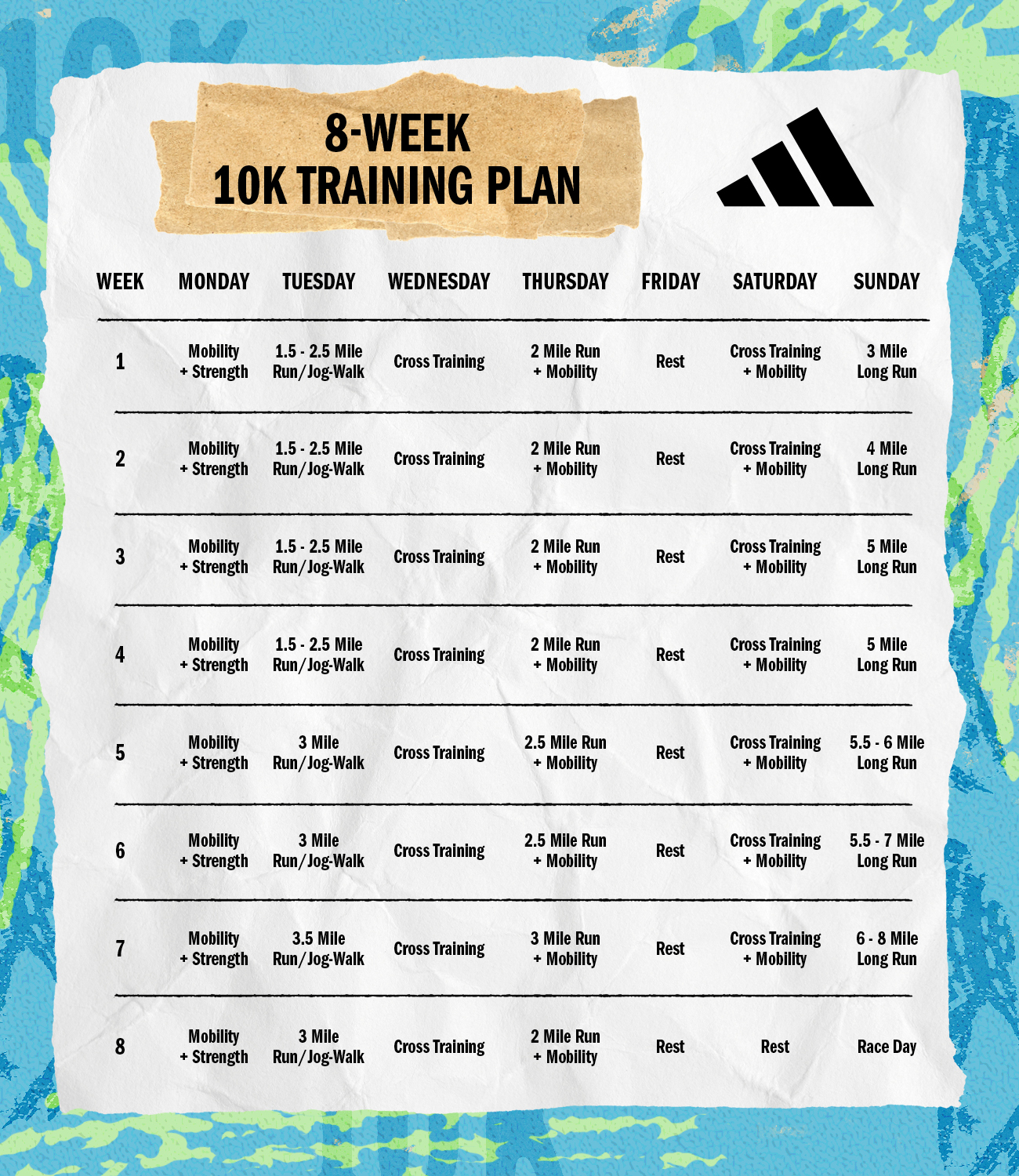
The initial few weeks of training will be all about preparation: “We’re going to start by just getting our feet underneath us, and start dialing into the mileage,” Swatloski says. “I would not recommend running more than three times a week, if we can help it, when starting off.”
The week begins with strength training exercises, followed by a short run, jog, or walk, and some cross training in the middle of the week; this could be biking, running up hills, or lifting weights. Here is an example of a two-day lifting routine you can follow:
Day 1: x3 Sets
- Step-Up x6 on each leg
- Inverted Row/TRX Row x10
- Goblet Squat x10
- ½ Kneeling Kettlebell Chop x6 on each side
- Dead bug Hook-lying Hold x20 on each side
Day 2: x3 Sets
- Kettlebell or Barbell RDL x6
- Push-Up x10
- 1-Leg Glute Bridge x10 on each side
- ½ Kneeling Kettlebell/Dumbbell Overhead Press x6 on each side
- Lateral Plank Dips x10 on each side
Towards the end of the week, we combine a short run with mobility training, followed by a rest day, rounding it all out with more cross training, mobility, and a longer three-mile run.
For weeks four through eight, you will be gradually running longer distances on Sundays, eventually up to eight miles — so long as you feel comfortable doing so, as Swatloski notes: "If your body feels good and your goal is to run a faster race, I do think there's a lot of benefit to getting past that distance for a 10K,” she says. "When you're between six and ten [miles], you're kind of safe. Once we get past ten, depending on who you are and what you're training for, it gets a little bumpy."
More Tips for Running a 10K: Running Shoes, Mindset and More
As far as specific running shoes that Swatloski recommends, she says “the Boston 12s and the [Adizero] Adios Pro 3s are my go-to." We’ve also written a guide to help find the right running shoes for you.
More than any of the tips for running a 10K, you should be comfortable and at ease to be in the best mindset for your training. “Running should feel good. You should enjoy it, and it shouldn’t hurt,” Swatloski emphasizes. “If it’s hurting, that means you’re running too fast — so, you’re running outside your pace, or you’re running too often.”
“I think taking it slow is going to help you get into the right mental space,” she continues. “When you go out for your run, accepting the fact that ‘Hey, I’m going to run at a 12-minute pace today — and I’m okay with that.’ Then just let your thoughts wander a little bit. Let your mind be in a positive space to set yourself up for success; mindset is such a big part of it.”
Finally, Swatloski also stresses the importance of not feeling pressured to run faster or harder: “Don’t compare yourself to other runners. It's so easy to go out on a run and look at that person that's just zooming by you and think, ‘what am I doing wrong?’ You're doing nothing wrong. If your body feels good, if you're happy, if you're enjoying yourself, then that's awesome. Keep going down that road.”